Saturday, April 6, 2019

Backstage Passes: Gary Heller, Photographer Extraordinaire

An interview with Gary Heller, 

Production Photographer

for Mosaic Dance Theater Company


A live dance performance moves through air and vanishes in a breath.  Blink, and you can be sure to miss something.  But when a photographer captures one of those moments -- the suspension of the energy, focus, heartbeat, and passion -- the result is breathtaking.  Gary Heller is one of those photographers.  Exquisitely photographing MDTC's main stage concerts since 2008, Gary has provided the "face" of MDTC with his award-winning images.  
You can find Gary's galleries at: https://www.garyhellerphotography.com/ 
(All photos below by Gary Heller -- of course!)

How did you become involved in photography?

It was sometime in 2000 or 2001 that a friend of the family gave me some camera gear belonging to her late husband.  It was a Canon AE1 35mm film camera with some lenses and various accessories.  I had a mild interest in photography after dabbling on and off through the years with painting, and realizing that painting didn't come easily to me.  I had a cheap point-and-shoot digital camera that I played around with, and enjoyed catching scenes that interested me and composing them in ways that I thought were even more interesting.  I felt photography was something that I enjoyed.

Having the good quality camera given to me really lit the fire to my interest in it.  I soon upgraded to a more modern film camera and lenses, and would scan my negatives into hi-res digital files, which allowed me to then edit and catalogue my work on the computer.  Eventually, sometime in 2007 I purchased a full frame DSLR.
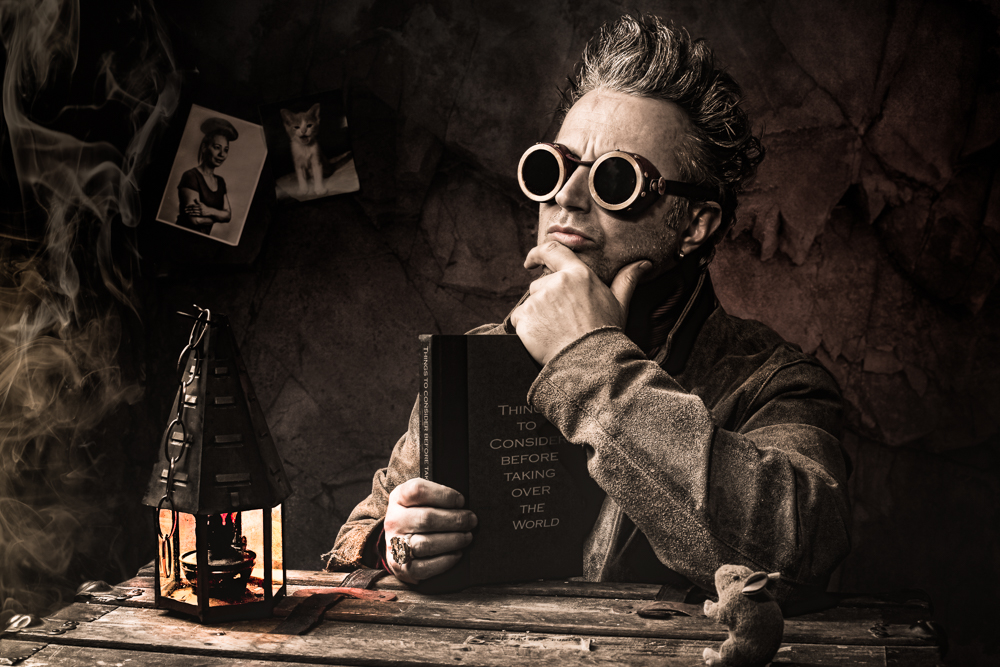
(Two distinctly different self portraits of Gary Heller.)


What drew you to dance photography?

Nina Brewton


When Nina Brewton and I met in 2005, she was performing with Mosaic Dance Theater Company.  She asked me if I would consider shooting the performances for the Company.  I had never thought about photographing anything other than the old barns, abandoned things and places and other various subjects of kind, so it sort of took me by surprise actually. I decided to give it a go.  I found it to be quite challenging, but at the same time it can be very rewarding when you look through the shots afterward and see the images that came out well.
Some of Gary's striking images.


Can you note any differences working with dance vs. other types of moving photography?

Shooting for MDTC makes up most of my experience when it comes to action/moving subjects.  I've assisted in a few weddings and some event photography, but it's nothing like dance.  What I can say is shooting dance performances in a theater would be just about as difficult and challenging as it gets, due to the low light conditions and the number of dancers constantly moving quickly about the stage.  Trying to catch a moment when all the subjects are in place and everything comes together can be daunting.

Is there any piece in Mosaic's repertory that has particular meaning for you, and why?

That's a tough one.  MDTC's repertory is quite vast, and there is so much that I like. I'll have to name at least three that come to mind right away.  Pandora's Box (The Paradise of Children), Ubar, the Lost City of Brass, and Fo(u)r Women.  I just simply feel they are great productions of exceptional stories.  They really shine for me.  I also have to mention the commedia dell'arte (La Lettera d'Isabella)!  That adds to my challenge of photographing the performance, as I often wind up trying not to move while shooting and laughing out loud. (Gary's faves shown clockwise from upper right.)

What are the challenges for you of working in dance and theatrical photography?

El Zar
 Well, the challenges really are the lighting, number of fast moving subjects on stage at any given time, and catching the right moment while it's all happening very quickly. 
  The camera gear has to be up to the task of being able to expose in a low light situation with enough shutter speed to freeze the action while maintaining adequate sharpness.  The camera also has to be able to focus quickly and accurately in low light.  Today's high-end DSLRs are mostly capable of all of this, and using fast glass (lenses) helps as well.  The challenge then becomes mine in setting up the camera for the task, trying to anticipate when to fire off a burst of shots in the hopes that one will have the right moment, exposure and sharpness.  It later goes into a workflow of sorting through the hundreds of images captured, and weeding out the poor shots from the good ones.  Then going through the good captures and tweaking exposure, cropping as needed, and preparing them to hand off to the Company.  The challenges are rewarding though, and I enjoy it very much.


How has your time with Mosaic changed or enhanced your experience in photography?

One of Gary's award-winning images - Fantasie Orientale
 Simply, my experience shooting the MDTC performances has forced me to learn a lot more about my gear that I would have if I just continued shooting barns and landscapes.  It has also required me to hone my skills so I can take full advantage of the capabilities of the gear I work with.  That has helped me in other areas of photography as well, and so I'd say I'm all the better for it.


I'm looking forward to the next performance.


Saturday, March 23, 2019

Backstage Passes: Nick Von Hagel Managing Director of Westminster Arts Center


An interview with Nick Von Hagel, Lighting Designer

for Mosaic Dance Theater Company 

    You may not know Nick Von Hagel by sight, but if you've seen our productions at Westminster Arts Center (WAC), you know his work! His sorcery with light gives Sir Isaac Newton pause. As Managing Director of WAC at Bloomfield College, Nick is responsible for the technical aspects of the theater.  In addition he is "it" for managing the countless operational details necessary to keep this popular venue at the ready, not only for Bloomfield College, but for the many arts organizations which, like MDTC, call WAC "home."  Here's your chance to get to know "the guy in the booth."

How did you become involved in technical theater? 
   I became involved in theater about mid-way through my sophomore year of high school.  A number of my friends were assisting with our production of Little Shop of Horrors, so if I was looking to hang out with them after school, I ended up with only one option -- working on the show with them. From building sets to working on lighting crews,
Nick Von Hagel at the sound console at WAC.
I became stoked for every new production we put on. My father, who was a hobby woodworker and built a number of pieces of my bedroom and our living room furniture, instilled in me an enjoyment for working with my hands. Using some of those skills taught by my father for theater was a catalyst for me.  I had never had much desire to just make things out of wood beyond spending time with him and assisting my father, previous to my high school introduction to theater.
What drew you to lighting design?
   Necessity! Though I design lighting for Mosaic, my primary expertise is in live mixing, skills and practice brought on after attaining my position as the Technical Director of the Westminster Arts Center.  Many people will be okay with a simple lighting design, lights up/down, but most people can't stand bad/unclear audio.  For many events that require both lighting and sound, I'll generally fulfill the sound mixing role for those reasons.  But as live reinforcement is not needed by many dance shows, and minimally even for Mosaic, I get to do the other thing I love -- stage lighting.
Can you note any differences working with dance theater vs. theater?    

   I think dance theater sometimes has more impact than a standard theatrical production.  Dance theater is so much more about conveying mood through lighting and music.  Which is not to say those things are not conveyed using those disciplines in other arts forms.  Narration/exposition are simpler in a dance theater piece so you require a little more from the other technical/artistic aspects to flesh out such pieces.
Is there any piece in Mosaic’s repertory that has particular meaning for you, and why?  


 I particularly like Ubar, The Lost City of Brass, maybe because it lets me lean on a color palette that I usually shy away from for many other lighting needs I fulfill. Ubar also runs the full gambit of storytelling and emotion from slow and sneaky mysterious action to "run for your life." 
(At left are the many moods of Ubar, The Lost City of Brass, from MDTC's production of Tales from the Arabian Nights, with examples of Nick's exquisite lighting. Photos by Gary Heller.)


What are the challenges for you, working in technical theater?  
    The moment of having to accept the technical limitation for what my artistic vision may be for a given moment.  Sometimes having to sit back and realize that I don't have the twenty thousand dollar magic bullet light, or the perfect lighting angle to get it the effect I want.  In the end, working with your space with the  equipment you have available to you, while still creating something amazing is something a technical artist needs to come to terms with.  
(A special lighting effect achieved in Fo(u)r Women. Photo by Gary Heller.)
How has your time with Mosaic changed or enhanced your experience in technical theater?   


Mosaic was one of my first ventures into lighting and working on dance theater.  I had designed and worked on many productions through my college years, but Mosaic was one of my first times delving into "artistic" lighting design outside of the safe "higher education" world.  I'm grateful to Mosaic for their patience with me and that first show in 2008, as I fought the terror of what I feared
may end up to be horrible lighting (it wasn't),  but terrifying nonetheless.  Ten years later, I look forward to the next time Mosaic is on my calendar, and what new story piece they may have for me to play with. 
(At left, two pieces from MDTC's 2008 production at WAC, Red Desert  and The Boating Party. Nick's lighting design captures just the perfect quality for the particular moment in each dance.  Photos by Gary Heller.)